
How Ransomware Attacks Are Shutting Down Cannabis Businesses
Ransomware can shut down a cannabis business in minutes. Learn how attacks happen, why the industry is targeted, and how to prevent costly downtime.

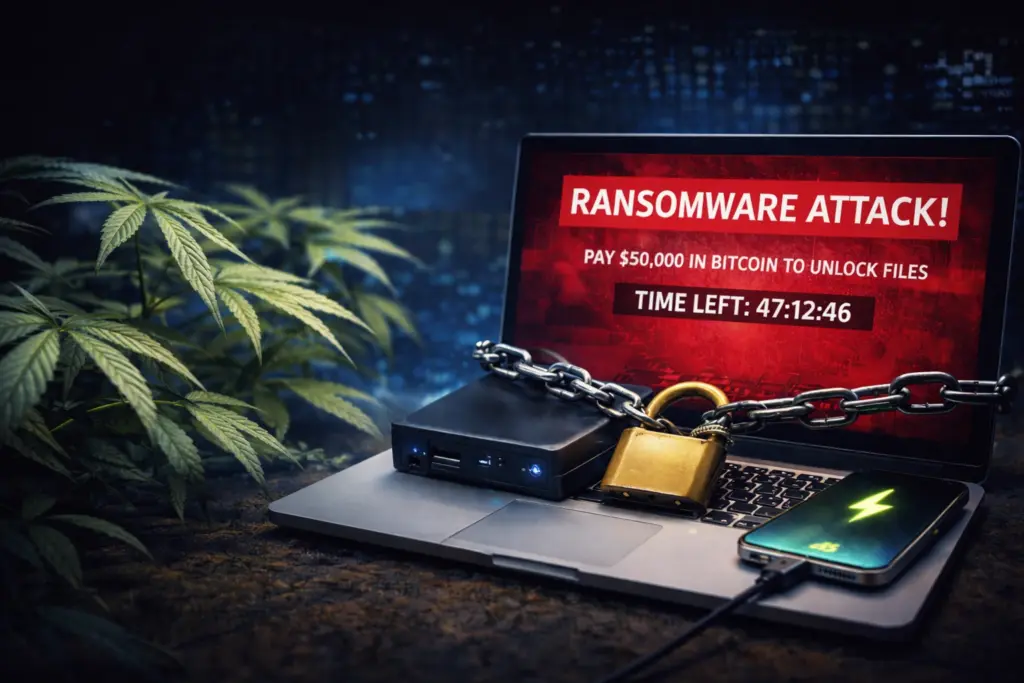
Picture this: You arrive at your dispensary Monday morning, ready for another busy week. You try to log into your seed-to-sale tracking system—and you’re locked out. A message flashes on your screen demanding $50,000 in Bitcoin to unlock your data.
Welcome to the world of ransomware. And if you’re in the cannabis industry, you’re a prime target.
Ransomware is malicious software that encrypts your critical business data and holds it hostage until you pay up. It’s not just a tech problem—it’s a business-crippling nightmare that can shut you down completely.
Cannabis businesses face a perfect storm of vulnerability. You’re cash-rich, heavily regulated, and often underprotected. Hackers know you can’t afford downtime. Miss a compliance deadline because your tracking system is locked? That’s not just lost revenue—that’s potential license violations, regulatory fines, and even the risk of losing your license entirely.
The math is simple for criminals: high pressure + deep pockets = willing to pay. They’re betting you’ll choose to pay the ransom rather than face weeks of downtime, regulatory scrutiny, and potential business closure.
And here’s the thing—they’re often right. Studies show that about 60% of ransomware victims end up paying. But that doesn’t mean you should, and we’ll get to why in a minute.
Let’s talk numbers, because they’re sobering. The average ransomware payment hit $1.54 million in recent years. But that’s just the ransom itself—the tip of a very expensive iceberg.
Add in everything else:
Suddenly, you’re looking at losses that can shut down a business permanently.
One Colorado dispensary chain lost three weeks of sales when ransomware hit their inventory system. They couldn’t sell product they couldn’t track—state law requires real-time tracking for every transaction. The total damage? Over $200,000 in lost revenue, plus another $75,000 in IT remediation costs, plus $30,000 in legal fees. And that’s before counting the ransom they ultimately paid ($40,000) and still didn’t get all their data back.
Another Nevada operation paid $85,000 in ransom, only to discover the decryption key was faulty. They recovered about 60% of their data. The rest was gone forever. They ended up rebuilding from partial backups and manually reconstructing months of compliance records to satisfy state regulators.
Ransomware doesn’t magically appear on your systems. It sneaks in through predictable paths—and knowing these paths is the first step to blocking them.
Phishing emails are the #1 entry point. An employee clicks a link in what looks like a vendor email—maybe from your seed-to-sale provider, your landlord, or even your accountant. The link downloads malware in seconds. Sometimes it’s an attachment—a fake invoice, a shipping notification, a compliance document. Once opened, the ransomware quietly spreads across your network.
Modern phishing emails are frighteningly convincing. They use your vendor’s actual logos, similar email addresses ([email protected] instead of [email protected]—notice the “1” instead of “i”), and they reference real business contexts. An employee making dozens of decisions per day might not catch the subtle signs.
Unpatched software creates open doors. That point-of-sale system you haven’t updated in six months? It’s probably running known vulnerabilities that hackers can exploit. Security researchers publish vulnerability details to help companies patch them—but criminals read those same reports to find targets who haven’t patched yet.
Software vendors release patches for a reason. When you ignore updates, you’re leaving known security holes open. It’s like knowing your back door lock is broken and deciding to fix it “later.”
Weak passwords make it easy. “Cannabis2024!” isn’t going to cut it anymore. Neither is “Dispensary123” or “GreenLife2025.” Hackers use sophisticated tools that can try billions of password combinations per second. Simple passwords fall in minutes.
And password reuse is even worse. If employees use the same password for work accounts and personal accounts, a breach of their personal email (which they might not even know about) gives attackers access to your business systems.
Remote access tools without proper security let attackers waltz right in. Many cannabis businesses use remote desktop tools so IT support can help from off-site or so managers can check systems from home. If these tools aren’t secured with multi-factor authentication and strong access controls, they’re highways for ransomware.
Criminals actively scan the internet for exposed remote desktop connections. When they find one with weak credentials, they’re in. From there, they explore your network, identify critical systems, and deploy ransomware when it’ll cause maximum damage—often late Friday night or before a holiday weekend when response times are slowest.
Compromised credentials from data breaches provide another entry point. Billions of username and password combinations from breaches at other companies are available on the dark web. Attackers try these credentials everywhere, betting that people reuse passwords. If one of your employees’ credentials was exposed in a breach at a completely unrelated company, and they used the same password for your business accounts, attackers can get in.
Understanding how attacks unfold helps you spot them earlier and respond faster.
Day 0-3: Initial compromise. The attacker gains access through phishing, weak passwords, or exploited vulnerabilities. They’re quiet at this stage, establishing a foothold and avoiding detection.
Day 4-14: Reconnaissance and lateral movement. The attacker explores your network, mapping out systems, identifying valuable data, locating backups, and escalating privileges. They’re looking for domain administrator credentials that give them control over everything. They disable security tools and delete or encrypt your backups so you can’t recover without paying.
This is the phase where early detection makes all the difference. If you catch them now, you can stop the attack before ransomware deploys.
Day 15-21: Data exfiltration. Many modern ransomware gangs steal your data before encrypting it. This gives them double leverage: they threaten to encrypt your systems AND to publish sensitive customer data or business information if you don’t pay. This is called “double extortion,” and it’s increasingly common.
Day 21+: Ransomware deployment. Usually late at night or during weekends, the attackers deploy ransomware across your network simultaneously. Systems lock up. Files become inaccessible. Ransom notes appear everywhere.
By the time you see the ransom message, they’ve been in your network for weeks.
Good news: You can dramatically reduce your risk with smart, practical steps. None of these require massive budgets or technical expertise—they just require commitment and consistency.
Back up everything—and store backups offline. This is your insurance policy and your best defense. If ransomware hits and you have clean backups stored offline or in immutable cloud storage, you can restore your data without paying a dime.
Here’s what “good backups” means:
The 3-2-1 rule is your friend: 3 copies of your data, on 2 different types of media, with 1 copy off-site or offline.
A California dispensary survived a ransomware attack with zero downtime because they had tested backups. When ransomware hit, they disconnected infected systems, wiped them clean, restored from backups, and were operational again in four hours. Total cost: $3,000 in IT time. Compare that to the six-figure losses other businesses face.
Train your team regularly. Your employees are your first line of defense. Teach them to spot phishing emails, verify suspicious requests, and report anything odd immediately. Make it part of your culture, not just a one-time training.
Effective training includes:
Make security awareness part of new employee onboarding. Fifteen minutes of training on day one can prevent hundreds of thousands in losses.
Update and patch religiously. Set automatic updates for all software where possible. If that’s not possible, schedule monthly patch reviews and apply updates promptly.
Create an inventory of all software and systems. Track version numbers. Monitor vendor security bulletins. Prioritize critical security patches—apply them within 72 hours of release.
Most ransomware exploits known vulnerabilities that have patches available. The attackers are counting on you being too busy to update. Don’t give them that advantage.
Use multi-factor authentication (MFA) everywhere. Even if a hacker steals a password, MFA stops them cold. It’s like having a deadbolt on top of your regular lock.
Enable MFA on:
Use authenticator apps (Google Authenticator, Microsoft Authenticator) or hardware security keys rather than SMS-based codes when possible. They’re more secure.
Segment your network. Don’t let your POS system talk to your HR files. Don’t let office computers access your financial database. If ransomware gets in, network segmentation contains the damage to one area instead of spreading everywhere.
Basic network segmentation for cannabis businesses:
This doesn’t require expensive equipment—most modern routers and firewalls can handle basic segmentation.
Implement endpoint detection and response (EDR). Traditional antivirus catches known malware, but EDR watches for suspicious behavior patterns that indicate ransomware activity. It can catch attacks that signature-based antivirus misses.
EDR tools monitor for things like:
When EDR spots something suspicious, it can automatically isolate the affected device, stopping ransomware from spreading.
Have an incident response plan. When (not if) something happens, you need to know exactly who does what. Write it down. Practice it. Update it.
Your plan should include:
Run tabletop exercises where you walk through attack scenarios. Practice makes perfect—and panic during a real attack makes everything worse.
Monitor and audit regularly. Review logs for suspicious activity. Check failed login attempts. Monitor for unusual network traffic or data transfers. Many attacks are visible in logs days or weeks before ransomware deploys—if anyone’s looking.
Set up automated alerts for:
You don’t need a full-time security operations center. Many of these monitoring capabilities are built into existing tools—you just need to configure and review them.
Here’s the uncomfortable truth: paying doesn’t guarantee you’ll get your data back. About 40% of businesses that pay never recover their files completely. Some get partial data. Some get corrupted data. Some get nothing at all.
And paying funds criminal operations that will just hit someone else. The more victims pay, the more profitable ransomware becomes, the more attacks happen.
Law enforcement and cybersecurity experts universally recommend: don’t pay.
But we also know real businesses face real consequences. If your choice is between paying $50,000 and losing your $2 million annual revenue business, the decision feels impossible.
Here’s what to consider before paying:
If you’re considering paying, consult with:
They can help you understand options, negotiate with attackers if you decide to pay, and ensure you’re handling the situation legally and effectively.
But the best answer? Make sure you never have to make that choice. Invest in prevention now.
Ransomware attacks aren’t slowing down—they’re accelerating. Cannabis businesses in New Mexico and nationwide are in the crosshairs every single day.
Start with the basics: backups, training, and MFA. Then build from there. Each layer of protection you add makes you a harder target, and attackers usually move on to easier prey.
Don’t wait until you’re staring at a ransom note to take security seriously. By then, your options are limited and expensive. Act now, while you still have control.
Need help building ransomware defenses that actually work? Caldera Cybersecurity specializes in protecting businesses from real-world threats. We’re based in Albuquerque and understand the unique challenges cannabis businesses face—regulatory pressures, limited banking options, and the target on your back.
Contact us at 505-975-4470 or [email protected]. Let’s build a security plan that keeps you safe—and compliant.
Don’t wait for the ransom note to take security seriously.
Ransomware can shut down a cannabis business in minutes. Learn how attacks happen, why the industry is targeted, and how to prevent costly downtime.

How Hackers Target Cannabis Employees: Phishing Guide It’s 9 AM on a Tuesday morning. Your operations manager opens what looks like an urgent email from your seed-to-sale tracking vendor. “CRITICAL:
Learn how to safely vet SaaS integrations, reduce third-party risk, protect sensitive data, and avoid costly security and compliance failures.

Learn how to secure contractor access using Microsoft Entra Conditional Access. Automate access, enforce least privilege, and revoke logins automatically.

Learn how to prevent data leaks when using public AI tools. Protect PII, reduce risk, and use ChatGPT safely with practical security controls.
How to Secure Guest Wi-Fi with a Zero Trust Approach Guest Wi-Fi is a convenience your visitors expect and a hallmark of good customer service. But it’s also one of