
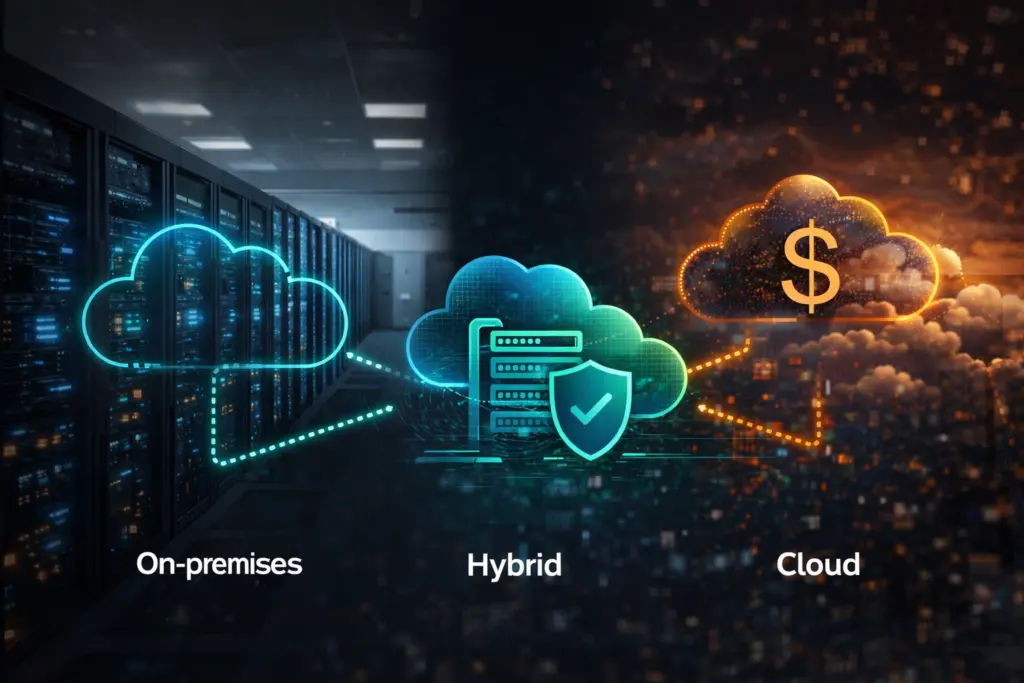
Cloud computing promised speed, simplicity, and scalability. For years, the message was simple:
“Move everything to the cloud.”
Many businesses did exactly that. However, once the migration wave settled, a new reality appeared.
Some workloads run beautifully in the cloud. Others become slower, more complex, or more expensive.
That is why many organizations are shifting to a smarter model for 2026:
Hybrid cloud.
A hybrid cloud strategy combines public cloud services like AWS, Microsoft Azure, or Google Cloud with private infrastructure such as on-premise servers or private data centers.
The goal is not to avoid the cloud. Instead, the goal is to use the cloud where it works best.
This flexible model lets businesses place each workload where it performs best—based on cost, speed, security, and compliance requirements.
Today, hybrid cloud is no longer a temporary solution. For many organizations, it is becoming the new standard for resilient IT infrastructure.
Cloud platforms use a pay-as-you-go model. This model works well for workloads that grow or shrink quickly.
However, for stable, predictable systems, cloud costs can climb over time.
For example, many businesses face unexpected expenses from:
• Data egress fees when moving data out of the cloud
• Over-provisioned resources running 24/7
• Always-on environments that were meant only for testing
These costs add up quickly.
Performance can also become an issue.
Some applications require very low latency or constant high-speed communication. If those systems run in a distant cloud data center, users may notice delays.
With a hybrid model, businesses can keep latency-sensitive workloads close to home while using the cloud for scalable services.
Hybrid cloud offers the best of both worlds.
During peak periods—such as seasonal sales spikes—businesses can scale into the public cloud to handle increased demand.
When traffic slows, workloads can move back to private infrastructure, reducing operating costs.
This flexibility helps companies control spending without sacrificing performance.
Hybrid cloud also helps organizations meet compliance and data sovereignty requirements.
Many industries must keep sensitive information within specific geographic regions or controlled systems. Examples include:
• Healthcare organizations handling patient records
• Financial institutions managing customer data
• Government agencies with strict security rules
• Legal firms protecting confidential information
Hybrid cloud allows businesses to store sensitive data on controlled infrastructure while still using the cloud for analytics, collaboration, or applications.
Not every system belongs in the cloud.
In many cases, private infrastructure is the better option.
Here are a few common examples.
Some organizations run older software that is difficult to migrate. In other cases, proprietary systems perform better on dedicated hardware.
Keeping these systems on-premise can reduce both risk and cost.
Moving large volumes of data in and out of the cloud can trigger high transfer fees.
For data-heavy workloads, running applications locally may be far more cost-effective.
Certain environments require consistent, predictable performance.
Examples include:
• manufacturing automation systems
• financial trading platforms
• large enterprise databases
• real-time analytics engines
These workloads often perform best on dedicated infrastructure.
Hybrid cloud offers flexibility, but it also introduces complexity.
Success depends on how well your environments connect and work together.
First, organizations need secure, high-speed connectivity between on-premise systems and cloud platforms. Many companies achieve this through services like:
• AWS Direct Connect
• Microsoft Azure ExpressRoute
• private fiber connections
These connections provide reliable, low-latency communication between environments.
Second, businesses should implement unified management tools.
A single dashboard that monitors performance, costs, and security across both environments makes operations far easier to manage.
Container technologies such as Kubernetes can also simplify hybrid environments. Containers allow applications to run consistently across both cloud and on-premise infrastructure.
A successful hybrid strategy begins with visibility.
Start by auditing your applications and systems. Identify which workloads are:
• cloud-native and scalable
• latency-sensitive
• legacy or difficult to migrate
• handling sensitive or regulated data
This process helps determine where each workload should live.
Next, launch a small pilot project.
A common starting point is cloud-based disaster recovery.
For example, organizations can store secure backups of on-premise systems in the cloud. This provides protection without disrupting daily operations.
Once the foundation is stable, workloads can move gradually into the hybrid environment.
Hybrid cloud is not about choosing between cloud or on-premise infrastructure.
It is about placing workloads intelligently.
This approach helps organizations:
• reduce cloud spending
• improve performance
• strengthen security
• avoid vendor lock-in
• build more resilient systems
Technology will continue to evolve. New cloud services will appear, and infrastructure models will change.
A hybrid foundation gives your business the flexibility to adapt without starting over.
In 2026 and beyond, success will not come from moving everything to the cloud.
Instead, it will come from using the cloud strategically.
A well-designed hybrid cloud environment improves performance, reduces costs, and strengthens security.
However, building that architecture requires careful planning.
At Caldera Cybersecurity, we help businesses:
• evaluate current infrastructure
• identify cloud-ready workloads
• design secure hybrid architectures
• implement scalable and resilient systems
If you’re planning your next phase of cloud infrastructure, now is the time to build a smarter strategy.
Contact Caldera Cybersecurity today to design a hybrid cloud environment that supports your long-term business goals.